
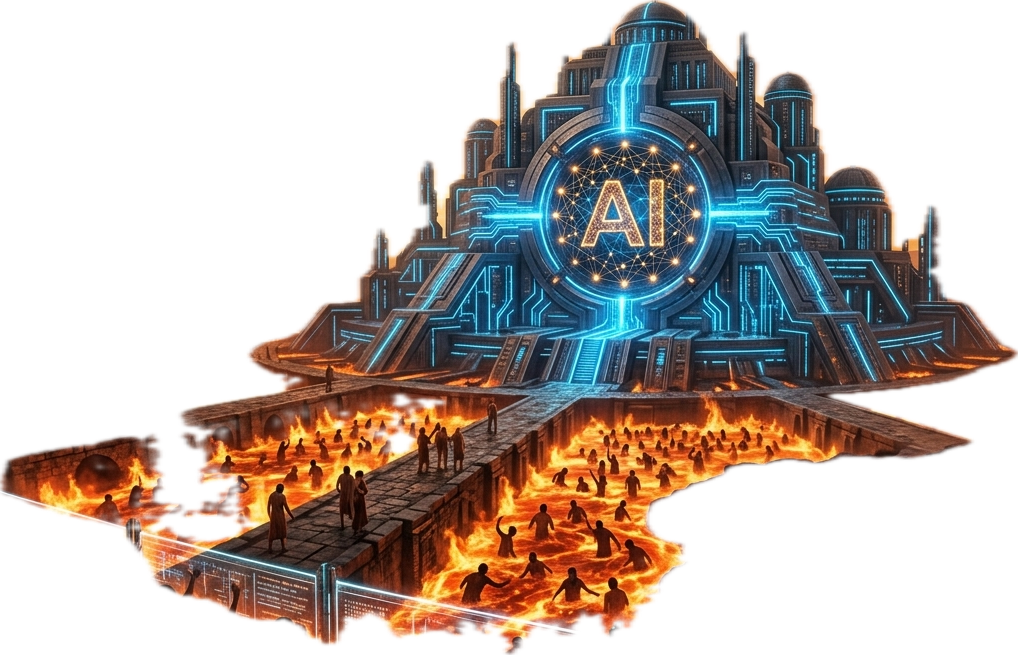
With no regulation, AI is coming for our jobs! Then what?!
The immediate future of AI is marked by an intense, multi-faceted "battle" across several key domains: An AI generated report.
Technological supremacy, commercial application and market dominance, and the critical areas of safety, ethics, and regulation. This competition involves tech giants, startups, and nation-states, with significant geopolitical and economic implications.
Technological Battlegrounds
Artificial General Intelligence (AGI) and Superintelligence: The race to develop AI that matches or surpasses human cognitive abilities is a central focus. This involves not just large language models (LLMs), but developing "world models" that understand concepts and physical environments.
Hardware Innovation: Progress is dependent on specialized, energy-efficient chips (GPUs, TPUs, neuromorphic chips). The logistical and geopolitical challenges of producing this hardware create a significant point of competition and vulnerability in the supply chain.
Multimodal AI: The ability for AI systems to process and generate information across various modalities (text, images, audio, video) seamlessly is a key area of advancement, moving beyond single-modality models.
AI Agents and Embodied AI: A major shift is the development of autonomous AI agents that can plan, reason, and execute multi-step tasks or control physical robots (embodied AI). This moves AI from a reactive tool to a proactive, independent actor.
Commercial and Application Battlegrounds
Market Dominance and Integration: Tech giants like Google, Microsoft, and OpenAI are competing intensely to embed AI into existing software and services (e.g., Microsoft 365 Copilot, Google Workspace's Duet AI). The goal is to make AI assistants the new standard interface for work and daily life.
Industry-Specific Applications: There is a strong push to apply AI to critical sectors like healthcare (drug discovery, diagnostics), finance (fraud detection, risk assessment), manufacturing, and defense.
Data Scarcity and Synthetic Data: As the supply of high-quality human-generated data for training models dwindles, the use of AI-generated synthetic data is becoming a crucial method for continued model improvement.
Ethical and Governance Battlegrounds
Safety and Alignment: Ensuring powerful AI systems remain aligned with human values and operate safely is a critical challenge. Concerns about unintended consequences and misuse (e.g., advanced cyber weapons, disinformation) are driving an "arms race" in AI safety tools and expertise.
Regulation and Policy: Governments and international bodies are actively developing regulatory frameworks (like the EU AI Act) to manage risks. The debate over whether to accelerate or pause development, and who sets global standards, is a significant geopolitical battleground.
Bias and Transparency: Addressing algorithmic bias and the "black box" problem (understanding how models make decisions) is a persistent ethical and technical challenge, essential for building trust in AI systems.
Workforce Impact and Education: The potential for significant job displacement, particularly in entry-level and routine roles, creates societal tension. The focus is shifting to upskilling the workforce to collaborate with AI systems and developing new roles like prompt engineering and ethical monitoring
HOW CAN THE CURRENT AI BUBBLE BURST?
An AI bubble in the USA could burst due to factors like overvaluation, a lack of tangible returns on investment, declining corporate adoption, and overspending on infrastructure. A major trigger could be a crash in the stock prices of a few key AI companies, or a broader economic downturn exacerbated by the high concentration of wealth in a few AI-linked stocks.
Potential triggers for an AI bubble burst
Overvaluation and inflated expectations: High levels of investment have driven up valuations, but these might not be justified by actual AI performance or widespread, profitable adoption.
Lack of proven ROI: Many companies are struggling to show a clear return on investment from their AI projects, shifting the focus from broad promises to demonstrable proof of impact.
Declining corporate adoption: Some recent surveys indicate a slowdown or even a decline in corporate AI usage, suggesting that the expected surge in adoption is not materializing as quickly as predicted.
Infrastructure overspending: Massive investments in AI infrastructure, like data centers and powerful chips, could lead to overcapacity if demand doesn't keep pace, similar to the dot-com bubble's unused fiber optic cables.
Concentrated market gains: A significant portion of the S&P 500's gains are tied to a small number of AI-linked companies, creating a single point of failure for the broader market.
"Related party transactions": Some fear that AI giants are inflating their own valuations by engaging in "circular deals" where they invest in or provide financing to their customers, creating a false sense of demand.
Technical or economic limits: There are concerns that the cost of training and running large AI models is becoming prohibitively expensive, while the incremental improvements are flattening out.
Failure of generic AI: A belief that generic AI, like large language models, will not be sufficient to solve many complex, specialized problems, which could dampen demand for AI solutions in key sectors.
Possible outcomes
Market correction: A "market correction" where AI stock prices stabilize is more likely than a total "cataclysmic 'bubble bursting'," according to some analysts.
Systemic crash: If the bubble were to burst, it could trigger a wider economic downturn, as the wealth of the top 10% of households, fueled by AI stock gains, could evaporate.
Stunted progress: A burst could lead to a period of reduced investment, slowing down the pace of AI development, especially if it leads to decreased economic interest.

